
Assemblage des Centrioles-Diversité Ciliaire
Chef d’équipe : Bénédicte DURAND
Cilia | Centriole | Cytoskeleton | Cell architecture | Ciliopathies | Drosophila | Microtubules Muscle | Nesprin
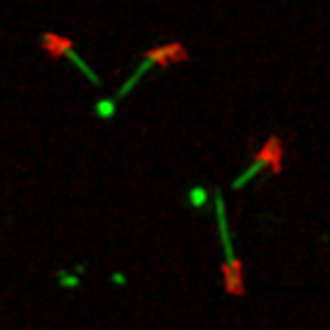
 Nous étudions les mécanismes qui contrôlent l’assemblage des cils à partir des centrioles et à l’origine de leur diversité. Nous cherchons ainsi à comprendre comment des défauts d’assemblage et/ou de fonction des cils entrainent des perturbations dans les cellules, les tissus et l’organisme qui, chez l’Homme, se traduisent par un large éventail de pathologies.
 Nous étudions les mécanismes qui contrôlent l’assemblage des cils à partir des centrioles et à l’origine de leur diversité. Nous cherchons ainsi à comprendre comment des défauts d’assemblage et/ou de fonction des cils entrainent des perturbations dans les cellules, les tissus et l’organisme qui, chez l’Homme, se traduisent par un large éventail de pathologies.
Une des étapes clés de l’assemblage des cils est la conversion du centriole en corps basal, processus strictement corrélé à la progression du cycle cellulaire. Un des défis actuels de la compréhension de l’assemblage des cils et des flagelles est notre capacité de résoudre l’organisation moléculaire de cette structure et d’identifier le rôle de chacun des constituants de cet assemblage hautement organisé. Pour cela des approches de microscopie haute résolution sont développées dans l’équipe : airyscan, 3D-SIM, microscopie électronique et microscopie d’expansion couplée à de la microscopie STED, appliquées à des tissus ciliés de drosophile ou des cellules de mammifère en culture afin de comprendre l’organisation moléculaire de la base des cils et la hiérarchie fonctionnelle d’assemblage de ses différents éléments constitutifs. Nous couplons ces capacités d’observations avec des outils de génétique fonctionnelle (dont édition du génome par CRISPR/Cas9). De plus nous développons des approches de biochimie (étiquetage de proximité) afin de comprendre la composition moléculaire des différents échafaudages ciliaires ou centriolaires. Grâce à ces approches combinées, nous avons déjà identifié plusieurs protéines qui sont impliquées chez l’Homme dans des pathologies ciliaires dont certaines sont également associées à des dégénérescences neuronales (sclérose latérale amyotrophique) et des pathologies du muscle cardiaque (cardiomyopathie). Nous cherchons à comprendre comment ces protéines contribuent à la biogenèse des cils et des centrioles et peuvent être à l’origine de ces différentes pathologies.
Pour le grand Public
Les cils et les flagelles sont de petites protrusions à la surface des cellules qui jouent des rôles variés : ils peuvent être mobiles et propulser des cellules (spermatozoïdes) ou des fluides (mucus respiratoire), ou immobiles et endosser alors le rôle d’antenne captant les signaux ambiants permettant à la cellule de s’adapter à son environnement. Des anomalies de formation ou de la fonction des cils sont responsables de nombreuses maladies héréditaires rares et souvent graves, appelées ciliopathies. Par ailleurs, les cils et leurs fondations, les centrioles, sont également des régulateurs importants des processus cancéreux en raison de leur rôle dans le contrôle de la division cellulaire et dans la communication entre cellules.
Notre équipe cherche à comprendre comment les cils sont assemblés à partir des centrioles et comment des variations autour d’un assemblage très conservé sont à l’origine de leur diversité de fonction. Nous développons pour cela des approches de génétique fonctionnelle, de biochimie et d’imagerie haute résolution, afin d’identifier et de comprendre la fonction de nouveaux gènes impliqués dans l’assemblage des cils. Nous exploitons principalement le modèle de la drosophile et des modèles cellulaires de souris ou humains. Nos travaux ont des retombées pour la compréhension des maladies associées à des dysfonctionnements de ces organelles.
Membres de l’équipe
- Bénédicte DURAND — ORCID — Professeur, UCBL, HDR –benedicte.durand@univ-lyon1.fr –04 78 77 28 13
- Marine LAPORTE — ORCID — Chercheur, INSERM – marine.laporte2@univ-lyon1.fr –04 26 68 82 99
- Véronique MOREL — ORCID — Chercheur, CNRS – veronique.morel@univ-lyon1.fr – 04 26 68 82 99
- Joëlle THOMAS — ORCID — MCU, UCBL – joelle.thomas@univ-lyon1.fr – 04 26 68 82 99
- Julien PERRICHET — AI UCBL – julien.perrichet@univ-lyon1.fr – 04 26 68 82 99
- Sarah DE FREITAS — Doctorante, UCBL – sarah.de-freitas@etu.univ-lyon1.fr – 04 26 68 82 99
- Anthony RABATÉ — Doctorant, UCBL – anthony.rabate@univ-lyon1.fr – 04 26 68 82 99
- Léo KRÜTTLI — Doctorant, UCBL – leo.kruttli@etu.univ-lyon1.fr – 04 26 68 82 99
- Jennifer VIEILLARD — AI, CNRS – jennifer.vieillard@univ-lyon1.fr – 04 26 68 82 99
- Flavie PERROT— Tech, INSERM – flavie.perrot@univ-lyon1.fr – 04 26 68 82 99
Alumni
- Marine BRUNET — Doctorante, UCBL
- Emilie JOUX — Stagiaire M2, UCBL
- Amélie BILLON — Doctorante, UCBL
- Alison CARRET — Doctorante, UCBL
- Emilie FONTAINE — Doctorante, UCBL
- Hajer MAARCHA — Stagiaire M2, UCBL
- Jean-André LAPART — Doctorant
- Céline AUGIERE — Doctorante
- Jennifer VIEILLARD — Doctorante
- Dominique BAAS — MCU
- Marie PASCHAKI — MCU
- Elisabeth CORTIER — AI
- Jean-Luc DUTEYRAT — AI
Sélection de publications
Drosophila Alms1 proteins regulate centriolar cartwheel assembly by enabling Plk4-Ana2 amplification loop
Résumé :
Cilia play critical roles in cell signal transduction and organ development. Defects in cilia function result in a variety of genetic disorders. Cep290 is an evolutionarily conserved ciliopathy protein that bridges the ciliary membrane and axoneme at the basal body (BB) and plays critical roles in the initiation of ciliogenesis and TZ assembly. How Cep290 is maintained at BB and whether axonemal and ciliary membrane localized cues converge to determine the localization of Cep290 remain unknown. Here, we report that the Cep131-Cep162 module near the axoneme and the Cby-Fam92 module close to the membrane synergistically control the BB localization of Cep290 and the subsequent initiation of ciliogenesis in Drosophila. Concurrent deletion of any protein of the Cep131-Cep162 module and of the Cby-Fam92 module leads to a complete loss of Cep290 from BB and blocks ciliogenesis at its initiation stage. Our results reveal that the first step of ciliogenesis strictly depends on cooperative and retroactive interactions between Cep131-Cep162, Cby-Fam92 and Cep290, which may contribute to the complex pathogenesis of Cep290-related ciliopathies.
Cep131-Cep162 and Cby-Fam92 complexes cooperatively maintain Cep290 at the basal body and contribute to ciliogenesis initiation
Wu Z., Chen H., Zhang Y., et al.. 🔗 https://doi.org/10.1371/journal.pbio.3002330
Résumé :
Cilia play critical roles in cell signal transduction and organ development. Defects in cilia function result in a variety of genetic disorders. Cep290 is an evolutionarily conserved ciliopathy protein that bridges the ciliary membrane and axoneme at the basal body (BB) and plays critical roles in the initiation of ciliogenesis and TZ assembly. How Cep290 is maintained at BB and whether axonemal and ciliary membrane localized cues converge to determine the localization of Cep290 remain unknown. Here, we report that the Cep131-Cep162 module near the axoneme and the Cby-Fam92 module close to the membrane synergistically control the BB localization of Cep290 and the subsequent initiation of ciliogenesis in Drosophila. Concurrent deletion of any protein of the Cep131-Cep162 module and of the Cby-Fam92 module leads to a complete loss of Cep290 from BB and blocks ciliogenesis at its initiation stage. Our results reveal that the first step of ciliogenesis strictly depends on cooperative and retroactive interactions between Cep131-Cep162, Cby-Fam92 and Cep290, which may contribute to the complex pathogenesis of Cep290-related ciliopathies.
PLOS Biology 22, e3002330 (2024)
Drosophila transition fibers are essential for IFT-dependent ciliary elongation but not basal body docking and ciliary budding
Hou Y., Zheng S., Wu Z., et al.. 🔗 https://doi.org/10.1016/j.cub.2022.12.046
Résumé :
Résumé non disponible.
Current Biology 33, 727-736.e6 (2023)
Drosophila Nesprin-1 Isoforms Differentially Contribute to Muscle Function
Rey A., Schaeffer L., Durand B., et al.. 🔗 https://doi.org/10.3390/cells10113061
Résumé :
Nesprin-1 is a large scaffold protein connecting nuclei to the actin cytoskeleton via its KASH and Calponin Homology domains, respectively. Nesprin-1 disconnection from nuclei results in altered muscle function and myonuclei mispositioning. Furthermore, Nesprin-1 mutations are associated with muscular pathologies such as Emery Dreifuss muscular dystrophy and arthrogryposis. Nesprin-1 was thus proposed to mainly contribute to muscle function by controlling nuclei position. However, Nesprin-1′s localisation at sarcomere’s Z-discs, its involvement in organelles’ subcellular localization, as well as the description of numerous isoforms presenting different combinations of Calponin Homology (CH) and KASH domains, suggest that the contribution of Nesprin-1 to muscle functions is more complex. Here, we investigate the roles of Nesprin-1/Msp300 isoforms in muscle function and subcellular organisation using Drosophila larvae as a model. Subsets of Msp300 isoform were down-regulated by muscle-specific RNAi expression and muscle global function and morphology were assessed. We show that nuclei anchoring in mature muscle and global muscle function are disconnected functions associated with different Msp300 isoforms. Our work further uncovers a new and unsuspected role of Msp300 in myofibril registration and nuclei peripheral displacement supported by Msp300 CH containing isoforms, a function performed by Desmin in mammals.
Cells 10, 3061 (2021)
Financements et soutien