Cilia assembly and development
Principal investigator: Bénédicte DURAND
Cilia | Centriole | Cytoskeleton | Cell architecture | Ciliopathies | Drosophila | Microtubules | Muscle | Nesprin
 Centrioles and cilia play fundamental roles in cell and tissue homeostasis in animals.
 Centrioles and cilia play fundamental roles in cell and tissue homeostasis in animals.
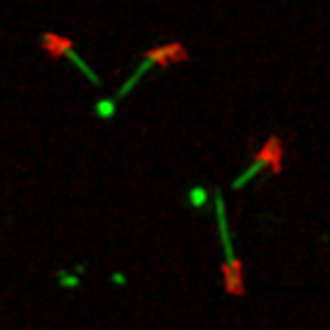
One of the key steps in cilia assembly is the conversion of the centriole to the basal body, a process strictly correlated with cell cycle progression. One of the current challenges in understanding cilia and flagellum assembly is our ability to resolve the molecular organization of this structure and to identify the role of each component of this highly organized assembly. For this purpose, high resolution microscopy approaches are developed in the team: airyscan, 3D-SIM, electron microscopy and expansion microscopy coupled with STED microscopy applied to Drosophila ciliated tissues or mammalian cells. This will help us to understand the three dimensional organization of these assemblies, but also the functional and temporal hierarchy of the constitutive elements. We combine these observations with functional genetics strategies in Drosophila (including CripsR/Cas9 genome editing) and in mammalian cell culture. In addition, we are developing biochemical approaches (proximity labeling) to understand the molecular composition of the centriolar or ciliary scaffolds. We have identified several proteins that are involved in human ciliary pathologies but also in neuronal degeneration (amyotrophic lateral sclerosis) and cardiac muscle pathologies (cardiomyopathy). We aim to understand how these proteins contribute to the biogenesis of cilia and centrioles and may be at the origin of these different pathologies.
For the general public
Cilia and flagella are small cellular protrusions at the cell surface that play various roles: they can be motile and propel cells (spermatozoa) and fluids (respiratory mucus), or they can be immotile and serve as cellular antennae capturing extracellular signals, allowing cells to respond and adapt to their environment. Abnormalities in cilia formation or function are responsible for many rare and often severe hereditary diseases, grouped under the term ciliopathies. More, cilia and centrioles on which they are built, are also important players in the regulation of cancerous processes because of their role in the control of cell division and cell signaling. Our team aims to understand how cilia are assembled from centrioles and what are the mechanisms underlying their diversity of function. We are developing functional genetic, biochemical and high-resolution imaging approaches to identify and understand the function of new genes involved in cilia assembly. We mainly use the Drosophila model and mouse or human cell models. Our work has implications for the understanding of diseases associated with dysfunctions of these organelles.
Join the team!
Characterizing the function of proteins associated with ciliopathies
The PhD project aims to understand the precise function of two proteins whose mutations in humans are associated with retinal ciliopathy. In this project, the PhD candidate will combine the power of functional genetic approaches in Drosophila (RNAi and/or CrispR-Cas9 genome editing) with cutting-edge imaging strategies (Expansion microscopy coupled with spinning-confocal and STED microscopies) and biochemical strategies to determine the contribution of each protein to cilia assembly and maintenance.
📅 Starting date : 1 October 2024.
Contact Prof. Bénédicte Durand
Team members
- Bénédicte DURAND — ORCID — Professeur, UCBL, HDR – benedicte.durand@univ-lyon1.fr – 04 78 77 28 13
- Marine LAPORTE — ORCID — Checheur, INSERM – marine.laporte2@univ-lyon1.fr – 04 78 77 28 65
- Véronique MOREL — ORCID — Chercheur, CNRS – veronique.morel@univ-lyon1.fr – 04 26 68 82 99
- Joëlle THOMAS — ORCID — MCU, UCBL – joelle.thomas@univ-lyon1.fr – 04 78 77 28 65
- Sarah DE FREITAS — Doctorante, UCBL – sarah.de-freitas@etu.univ-lyon1.fr – 04 78 77 28 65
- Julien PERRICHET — Technicien, UCBL – julien.perrichet@univ-lyon1.fr – 04 78 77 28 65
- Anthony RABATÉ — Doctorant, UCBL
- Jennifer VIEILLARD — IE, UCBL – jennifer.vieillard@univ-lyon1.fr – 04 78 77 28 65
Alumni
- Marine BRUNET — Doctorante, UCBL
- Emilie JOUX — Stagiaire M2, UCBL
- Amélie BILLON — Doctorante, UCBL
- Alison CARRET — Doctorante, UCBL
- Emilie FONTAINE — Doctorante, UCBL
- Hajer MAARCHA — Stagiaire M2, UCBL
- Jean-André LAPART — Doctorant
- Céline AUGIERE — Doctorante
- Jennifer VIEILLARD — Doctorante
- Dominique BAAS — MCU
- Marie PASCHAKI — MCU
- Elisabeth CORTIER — AI
- Jean-Luc DUTEYRAT — AI
Selected publications
Cep131-Cep162 and Cby-Fam92 complexes cooperatively maintain Cep290 at the basal body and contribute to ciliogenesis initiation
Wu Z., Chen H., Zhang Y., et al.. 🔗 https://doi.org/10.1371/journal.pbio.3002330
Résumé :
Cilia play critical roles in cell signal transduction and organ development. Defects in cilia function result in a variety of genetic disorders. Cep290 is an evolutionarily conserved ciliopathy protein that bridges the ciliary membrane and axoneme at the basal body (BB) and plays critical roles in the initiation of ciliogenesis and TZ assembly. How Cep290 is maintained at BB and whether axonemal and ciliary membrane localized cues converge to determine the localization of Cep290 remain unknown. Here, we report that the Cep131-Cep162 module near the axoneme and the Cby-Fam92 module close to the membrane synergistically control the BB localization of Cep290 and the subsequent initiation of ciliogenesis in Drosophila. Concurrent deletion of any protein of the Cep131-Cep162 module and of the Cby-Fam92 module leads to a complete loss of Cep290 from BB and blocks ciliogenesis at its initiation stage. Our results reveal that the first step of ciliogenesis strictly depends on cooperative and retroactive interactions between Cep131-Cep162, Cby-Fam92 and Cep290, which may contribute to the complex pathogenesis of Cep290-related ciliopathies.
PLOS Biology 22, e3002330 (2024)
Drosophila transition fibers are essential for IFT-dependent ciliary elongation but not basal body docking and ciliary budding
Hou Y., Zheng S., Wu Z., et al.. 🔗 https://doi.org/10.1016/j.cub.2022.12.046
Résumé :
Résumé non disponible.
Current Biology 33, 727-736.e6 (2023)
Drosophila Nesprin-1 Isoforms Differentially Contribute to Muscle Function
Rey A., Schaeffer L., Durand B., et al.. 🔗 https://doi.org/10.3390/cells10113061
Résumé :
Nesprin-1 is a large scaffold protein connecting nuclei to the actin cytoskeleton via its KASH and Calponin Homology domains, respectively. Nesprin-1 disconnection from nuclei results in altered muscle function and myonuclei mispositioning. Furthermore, Nesprin-1 mutations are associated with muscular pathologies such as Emery Dreifuss muscular dystrophy and arthrogryposis. Nesprin-1 was thus proposed to mainly contribute to muscle function by controlling nuclei position. However, Nesprin-1′s localisation at sarcomere’s Z-discs, its involvement in organelles’ subcellular localization, as well as the description of numerous isoforms presenting different combinations of Calponin Homology (CH) and KASH domains, suggest that the contribution of Nesprin-1 to muscle functions is more complex. Here, we investigate the roles of Nesprin-1/Msp300 isoforms in muscle function and subcellular organisation using Drosophila larvae as a model. Subsets of Msp300 isoform were down-regulated by muscle-specific RNAi expression and muscle global function and morphology were assessed. We show that nuclei anchoring in mature muscle and global muscle function are disconnected functions associated with different Msp300 isoforms. Our work further uncovers a new and unsuspected role of Msp300 in myofibril registration and nuclei peripheral displacement supported by Msp300 CH containing isoforms, a function performed by Desmin in mammals.
Cells 10, 3061 (2021)
Funding & Support