

Normal and pathological human embryology
Principal investigator: Alain CHEDOTAL
Embryo | Fetus | Development | Tissue clearing | Cell atlas | 3D imaging | Evolution | Developmental disorders | Light sheet microscopy | Cell Atlas
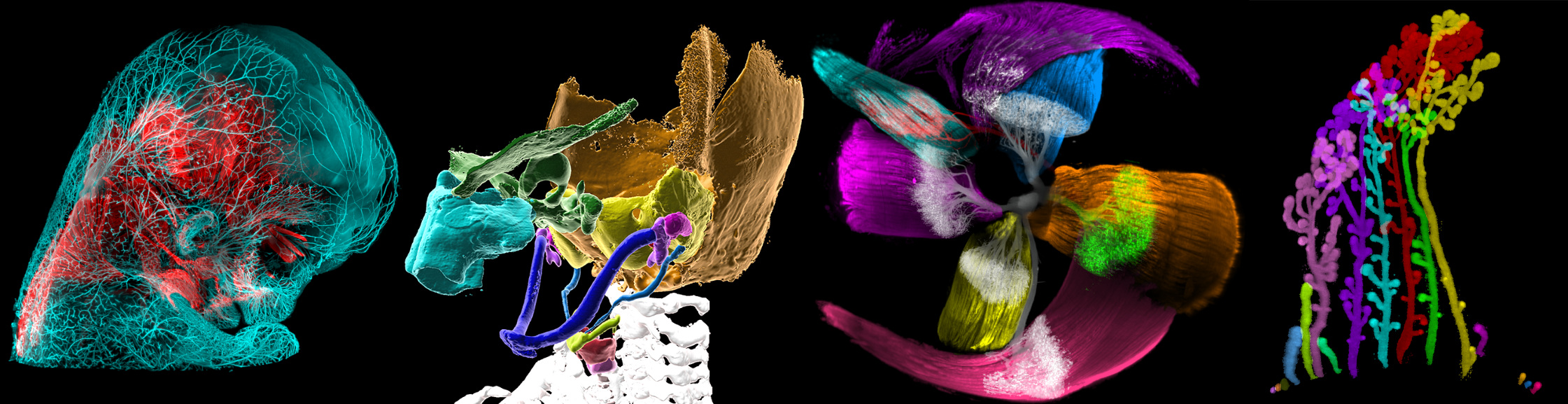
 Our team uses cutting-edge 3D imaging techniques, powerful image analysis pipelines and transcriptomics to study the development of several human organs and address long-standing questions in developmental biology.
Developmental diseases are a major public healthcare burden and today the molecular and cellular mechanisms that ensure correct tissue morphogenesis in humans remain largely unknown. We are trying to build high-resolution cellular maps of human embryonic organs including the nervous system, muscles, vasculature, skeleton and branched organs. This should help Understanding human development and the etiology of ontogenic diseases.
A tridimensional atlas of the developing human head
HuDeCa

HuDeCA (Human Developmental Cell Atlas) is a 5-year program initiated by Inserm to build a reference atlas of embryonic and fetal human cell types. The project has been designed from the outset to enable contributions to the Human Cell Atlas (HCA), an ambitious international initiative to map all normal cell states of the body at every human life stages.
Transparent Human Embryo

The Collection of Immunolabeled Transparent Human Embryos and Fetuses is the most advanced molecular embryology tool. Building upon the pioneering ‘DISCO’ clearing methods developed for rodent embryos, we have shifted gears to another level, where direct knowledge of molecular and cellular ontogenesis may prove critical to improve Human pregnancy.
Team members
- Alain CHEDOTAL — PUPH, UCBL, HDR
- Anaïs FAVRE — IE, UCBL
- Qingwei LI — Doctorant, UCBL
Selected publications
A tridimensional atlas of the developing human head
Blain R., Couly G., Shotar E., et al.. 🔗 https://doi.org/10.1016/j.cell.2023.11.013
Résumé :
Résumé non disponible.
Cell 186, 5910-5924.e17 (2023)
A human embryonic limb cell atlas resolved in space and time
Zhang B., He P., Lawrence J., et al.. 🔗 https://doi.org/10.1038/s41586-023-06806-x
Résumé :
AbstractHuman limbs emerge during the fourth post-conception week as mesenchymal buds, which develop into fully formed limbs over the subsequent months1. This process is orchestrated by numerous temporally and spatially restricted gene expression programmes, making congenital alterations in phenotype common2. Decades of work with model organisms have defined the fundamental mechanisms underlying vertebrate limb development, but an in-depth characterization of this process in humans has yet to be performed. Here we detail human embryonic limb development across space and time using single-cell and spatial transcriptomics. We demonstrate extensive diversification of cells from a few multipotent progenitors to myriad differentiated cell states, including several novel cell populations. We uncover two waves of human muscle development, each characterized by different cell states regulated by separate gene expression programmes, and identify musculin (MSC) as a key transcriptional repressor maintaining muscle stem cell identity. Through assembly of multiple anatomically continuous spatial transcriptomic samples using VisiumStitcher, we map cells across a sagittal section of a whole fetal hindlimb. We reveal a clear anatomical segregation between genes linked to brachydactyly and polysyndactyly, and uncover transcriptionally and spatially distinct populations of the mesenchyme in the autopod. Finally, we perform single-cell RNA sequencing on mouse embryonic limbs to facilitate cross-species developmental comparison, finding substantial homology between the two species.
Nature 635, 668-678 (2023)
Yolk sac cell atlas reveals multiorgan functions during human early development
Goh I., Botting R., Rose A., et al.. 🔗 https://doi.org/10.1126/science.add7564
Résumé :
The extraembryonic yolk sac (YS) ensures delivery of nutritional support and oxygen to the developing embryo but remains ill-defined in humans. We therefore assembled a comprehensive multiomic reference of the human YS from 3 to 8 postconception weeks by integrating single-cell protein and gene expression data. Beyond its recognized role as a site of hematopoiesis, we highlight roles in metabolism, coagulation, vascular development, and hematopoietic regulation. We reconstructed the emergence and decline of YS hematopoietic stem and progenitor cells from hemogenic endothelium and revealed a YS-specific accelerated route to macrophage production that seeds developing organs. The multiorgan functions of the YS are superseded as intraembryonic organs develop, effecting a multifaceted relay of vital functions as pregnancy proceeds.
Science 381, (2023)
Funding & Support